 Xem Studiomeasured geometry
Library › Aircraft design › Tail configurations ·
H-tail / twin fin tail
What is an H-tail (twin tail) and why use one? · Standard part · basis: Design rules and figures from the cited sources; example geometry by Xem Studio
Also called: h-tail, h tail aircraft, twin tail, twin fin, twin vertical stabilizer, double tail plane, h-tail bomber, twin rudder rc plane, endplate fins stabilizer
Exact dimensions. True size, with no tolerance added.
- sizes
- 2 in table
Notes
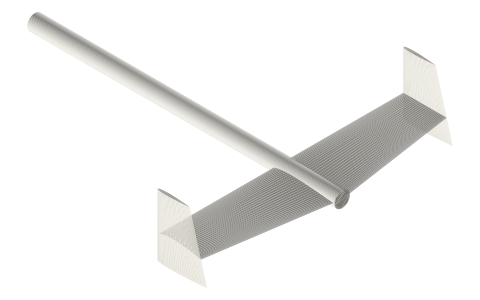
- An H-tail puts two fins at the ends of the horizontal stabiliser. Bhattacharya et al. list redundancy and fins less affected by wing/fuselage downwash and fuselage turbulence as benefits, with propwash drag and boom weight as costs.
- The stabiliser end-plates the fins in the same way a T-tail's stabiliser end-plates a single fin (Kitplanes T-Tails), and splitting the fin area keeps each fin short.
- Arnedo describes twin (H) tails as 'much less common' than conventional, cruciform and T-tails.
- Used on: Consolidated B-24, B-25 Mitchell, Avro Lancaster, Handley Page Halifax, Petlyakov Pe-2.
- The file is a reference example built by Xem Studio from the numbers above. Sizes the sources do not fix are illustrative; scale the example to your own vehicle.
H-tail / twin fin tail size chart
| parameter | value or range | source |
|---|---|---|
| Fin area split | total Sv shared by two fins (each 8,000 mm^2 in reference build) | computed from Vv 0.04 |
| Reference build | Sh 40,000 mm^2, two fins 100 x 80 mm | computed |
Where the files are
Other publishers' files are linked, not hosted. "verify" = check the license at the link before commercial use.
| engrXiv (Bhattacharya et al., ICMMM 2023) | Design and Computational Analysis of Y-tail Configuration for Maritime UAV | web | Publisher's page; dimensions are facts |
| LibreTexts (Arnedo, Fundamentals of Aerospace Engineering) | 2.2.3 Empennage | web | Publisher's page; dimensions are facts |
| Kitplanes (B. Wainfan) | Design Process: T-Tails (2022) | web | Publisher's page; dimensions are facts |
| HAW Hamburg (Aircraft Design and Systems Group) | Empennage sizing: tail lever arm as % of fuselage length (thesis; Table 2.1 typical tail volume coefficients) | web | Publisher's page; dimensions are facts |
Free files
★ Free files 1 parts. Xem Studio design: free to use, print and sell things from; not to be republished as files. Xem Studio Design License. index.json
Use this part in your AI. Your AI gets the exact sizes and files straight from Xem and can design a mount, case or adapter around it. Direct downloads here are limited to one file every 10 minutes; through your AI they are unlimited.
Connect Xem to your AI (free, no account, about a minute)
https://xemstudio.com/mcp- Claude: Add to Claude
- ChatGPT (Plus or higher): open Connectors → Advanced → turn on Developer mode → Create → paste the address, no authentication → Create.
- Cursor: install with one click. VS Code: install with one click.
| h-tail-twin-tail-tail | h tail layout: horizontal span 400 × chord 100, vertical 100 × 80 mm on a 500 mm boom, NACA 0009 surfaces | STEP · STL |
https://xemstudio.com/mcp to Claude, ChatGPT, Cursor or any MCP client (free, no account, one minute) and it can look up exact sizes, mating fits and free STEP/STL from every chat.Plain text: sheet.txt · JSON: /api/geometry?object=h-tail-twin-tail
Fits with


Questions
Why did WWII bombers use H-tails?
Twin fins give redundancy and sit outside fuselage turbulence (Bhattacharya et al.); examples include the B-24, B-25 and Lancaster.