 Xem Studiomeasured geometry
Library › Hardware › Pistons, cylinders & rods ·
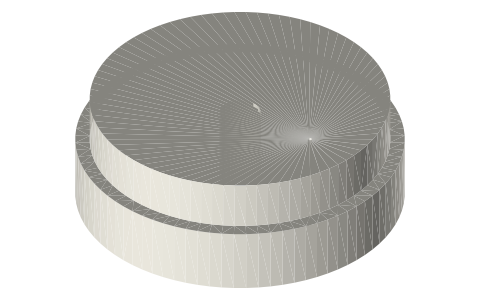
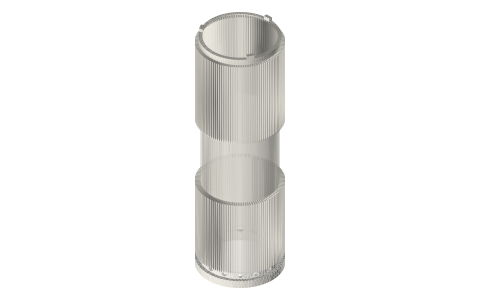
Clearance-seal hollow piston: Ø40.00 land, Ø38.50 body, 106 long
What hollow piston runs in a 40 mm liner with a clearance seal? · Hardware · basis: Design values; shuttle loss after Martini; land and gap sizes set by the cycle model
Also called: stirling displacer seal land, displacer clearance seal, low shuttle loss displacer
Used in Long Earth Society builds. Stirling engine displacer build (8" × 6"), aluminum flashing · Stirling engine displacer build (full walkthrough)
Exact dimensions. Every file is drawn at true size with no tolerance added. The holes and pins that meet another part are listed below under Mating features, with the fit each joint needs; open those by your process's clearance before making the part. Mating features
- sizes
- 3 in table
Notes
- The gas must go through the slotted heater, screens and cooler, not round the displacer. A short running land Ø40.00 × 8 at the cold end is a clearance seal in the liner bore; the body behind it is Ø38.50, a designed 0.75 mm radial gap that keeps the shuttle conduction low (the land is cold, the gap is where the temperature changes).
- Stroke 30 mm in both engines; the cold face comes to 10 mm from the hot spool's face and the hot end to 3.4 mm from the floor.
- The cap's Ø0.5 vent lets the inside follow the mean charge slowly, so the shell never carries the charge pressure; the rod screws into the cap's M6 hole and is locked by an M6 nut on the cold face.
Clearance-seal hollow piston: Ø40.00 land, Ø38.50 body, 106 long size chart
| part | od (mm) | length (mm) | fit |
|---|---|---|---|
| cap land | 40.0 | 8.0 | run (liner bore) |
| cap spigot | 36.5 | 6.0 | press (shell bore) |
| shell | 38.5 | 98.0 | designed 0.75 gap |
Mating features
Drawn at the exact size. Open press, slide, run and socket features by your process's clearance (tolerances by process); leave designed gaps and clamp fits as drawn.
| feature | exact | mates with | fit | files |
|---|---|---|---|---|
| land | Ø40.00 × 8 | liner bore Ø40.00 (clearance seal) | run | displacer-cap* |
| spigot | Ø36.50 × 6 | shell bore Ø36.50 | press | displacer-cap* |
| rod hole | M6 tapped (Ø5.0) × 12 | Ø6 rod, M6 end | designed | displacer-cap* |
| vent | Ø0.5 | lets the inside follow the mean charge | designed | displacer-cap* |
| body | Ø38.50 | liner bore Ø40.00: 0.75 radial gap | designed | displacer-shell* |
| shell bore | Ø36.50 | cap spigot | press | displacer-shell* |
Where the files are
Other publishers' files are linked, not hosted. "verify" = check the license at the link before commercial use.
| NASA (W. R. Martini) | Stirling Engine Design Manual, 2nd edition, NASA CR-168088 (1983): decoupled second-order losses (shuttle, conduction, flow friction, regenerator) | US government report | |
| Long Earth Society | Engine builds | web, video | LES site |
Free files
★ Free files 2 parts. Xem Studio design: free to use, print and sell things from; not to be republished as files. Xem Studio Design License. index.json
Use this part in your AI. Your AI gets the exact sizes and files straight from Xem and can design a mount, case or adapter around it. Direct downloads here are limited to one file every 10 minutes; through your AI they are unlimited.
Connect Xem to your AI (free, no account, about a minute)
https://xemstudio.com/mcp- Claude: Add to Claude
- ChatGPT (Plus or higher): open Connectors → Advanced → turn on Developer mode → Create → paste the address, no authentication → Create.
- Cursor: install with one click. VS Code: install with one click.
| displacer-shell-38.5x98 | displacer shell Ø38.50 × 98 (z 8–106), wall 1, closed hot end 1.5 with a 1.0 round | STEP · STL |
| displacer-cap-40-land | displacer cold cap: running land Ø40.00 × 8, spigot Ø36.50 × 6 into the shell (press), M6 tapped (Ø5.0) × 12, Ø0.5 vent | STEP · STL |
https://xemstudio.com/mcp to Claude, ChatGPT, Cursor or any MCP client (free, no account, one minute) and it can look up exact sizes, mating fits and free STEP/STL from every chat.Plain text: sheet.txt · JSON: /api/geometry?object=clearance-seal-hollow-piston-40
Fits with

Questions
Why a land only at the cold end?
A close fit along the whole length would carry heat from hot to cold on every stroke (shuttle loss scales with 1 / gap); the land seals where it is cold.