 Xem Studiomeasured geometry
Library › Airfoils › Other airfoils ·
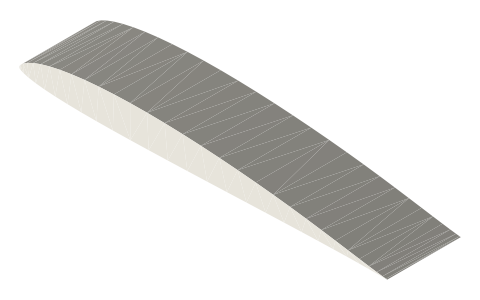
MH 32 airfoil
What is the MH 32 airfoil used for? · Standard part · basis: Coordinates from the UIUC Airfoil Coordinates Database; thickness, camber and section by Xem Studio
Also called: mh32, mh32 coordinates, hepperle mh32, f3b airfoil, f3j airfoil, mh32 dat, rc glider airfoil, mh32 flap, MH 32 coordinates, MH 32 dat, MH 32 STEP, MH 32 STL, MH 32 profile
Exact dimensions. True size, with no tolerance added.
- length
- 100.0 mm
- width
- 20.0 mm
- height
- 8.7 mm
Notes
- Martin Hepperle designed the MH 32 as a flapped airfoil for F3B and F3E models, intended to run negative flap for speed (MH-AeroTools).
- UIUC tests at Re 200,000-300,000 matched predictions for the upper laminar bucket; at Re above 100,000 drag rises below CL about 0.25, and Stuttgart tests extended useful range below zero lift with flap (MH-AeroTools).
- It remains a reference section: Model Aviation's soaring column compared newer F3J airfoils against the MH32 and SD7037 at Re 100k.
- MH 32: Martin Hepperle (MH series). Maximum thickness 8.70 % of chord at 30.1 % chord; maximum camber 2.40 % of chord at 44.4 % chord.
- Coordinates from the UIUC Airfoil Coordinates Database (M. Selig, UIUC Applied Aerodynamics Group), file mh32.dat, titled 'MH 32 8.7%'. Thickness and camber are computed by Xem Studio from those points (vertical distance at equal x, linear between points).
- The published trailing edge is sharp, so the section uses it as printed.
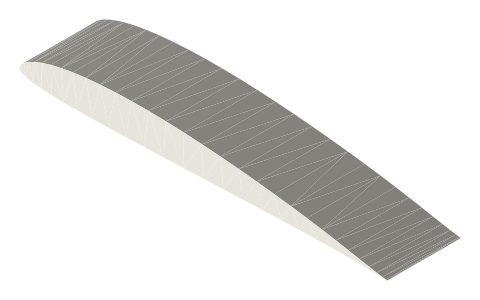
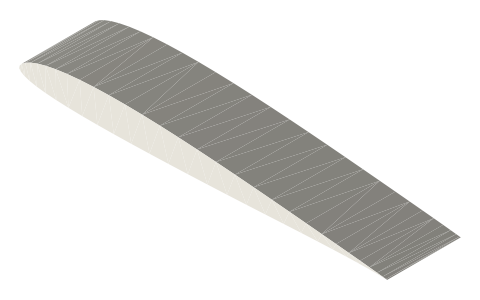
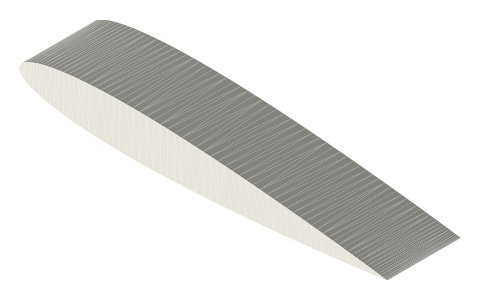
- The file is a 100 mm chord section, 20 mm deep: scale it uniformly to your chord, or import the STEP and sweep or loft it into a wing. Thickness scales with chord; the shape is the same at any size.
MH 32 airfoil size chart
| parameter | value | source |
|---|---|---|
| Max thickness | 8.70 % chord at 30.1 % chord | computed from the UIUC coordinates |
| Max camber | 2.40 % chord at 44.4 % chord | computed from the UIUC coordinates |
| Published points | 68 (35 upper, 34 lower, shared leading edge) | UIUC coordinates |
| Trailing edge as published | sharp (closed) | UIUC coordinates |
| y at x = 1.25 % chord | upper +1.497 / lower -0.825 % chord | linear between the published points (UIUC coordinates) |
| y at x = 2.5 % chord | upper +2.258 / lower -1.170 % chord | linear between the published points (UIUC coordinates) |
| y at x = 5 % chord | upper +3.317 / lower -1.587 % chord | linear between the published points (UIUC coordinates) |
| y at x = 7.5 % chord | upper +4.089 / lower -1.845 % chord | linear between the published points (UIUC coordinates) |
| y at x = 10 % chord | upper +4.682 / lower -2.016 % chord | linear between the published points (UIUC coordinates) |
| y at x = 15 % chord | upper +5.541 / lower -2.176 % chord | linear between the published points (UIUC coordinates) |
| y at x = 20 % chord | upper +6.088 / lower -2.214 % chord | linear between the published points (UIUC coordinates) |
| y at x = 25 % chord | upper +6.433 / lower -2.173 % chord | linear between the published points (UIUC coordinates) |
| y at x = 30 % chord | upper +6.617 / lower -2.078 % chord | linear between the published points (UIUC coordinates) |
| y at x = 40 % chord | upper +6.580 / lower -1.791 % chord | linear between the published points (UIUC coordinates) |
| y at x = 50 % chord | upper +6.145 / lower -1.432 % chord | linear between the published points (UIUC coordinates) |
| y at x = 60 % chord | upper +5.392 / lower -1.043 % chord | linear between the published points (UIUC coordinates) |
| y at x = 70 % chord | upper +4.363 / lower -0.658 % chord | linear between the published points (UIUC coordinates) |
| y at x = 80 % chord | upper +3.030 / lower -0.311 % chord | linear between the published points (UIUC coordinates) |
| y at x = 90 % chord | upper +1.475 / lower -0.057 % chord | linear between the published points (UIUC coordinates) |
| y at x = 95 % chord | upper +0.683 / lower +0.008 % chord | linear between the published points (UIUC coordinates) |
| Design use | flapped F3B / F3E | MH-AeroTools |
| UIUC test Re | 200,000 and 300,000 | MH-AeroTools |
| Stuttgart (IAG) test Re | 100,000 and 200,000; flap -3, 0, 5, 10 deg | MH-AeroTools |
| Lower bucket limit (Re > 1e5) | CL about 0.25 | MH-AeroTools |
| LE geometry sensitivity | 0.25% chord deviation shifted bucket ~0.1-0.2 CL | MH-AeroTools |
| Coordinates source | UIUC Airfoil Coordinates Database: mh32.dat ('MH 32 8.7%') | UIUC Applied Aerodynamics Group (M. Selig) |
Where the files are
Other publishers' files are linked, not hosted. "verify" = check the license at the link before commercial use.
| UIUC Applied Aerodynamics Group (M. Selig) | UIUC Airfoil Coordinates Database: mh32.dat ('MH 32 8.7%') | web | UIUC Airfoil Coordinates Database, public research data; coordinates are facts, cited and linked, not rehosted |
| UIUC Applied Aerodynamics Group (M. Selig) | UIUC Airfoil Coordinates Database (original: Martin Hepperle (MH series)) | web | UIUC Airfoil Coordinates Database, public research data; coordinates are facts, cited and linked, not rehosted |
| MH-AeroTools (M. Hepperle) | MH 32: Some Wind Tunnel Results | web | Publisher's page; dimensions are facts |
| Model Aviation (AMA) | Radio Control Soaring column, July 2002 | web | Publisher's page; dimensions are facts |
Free files
★ Free files 1 parts. Xem Studio design: free to use, print and sell things from; not to be republished as files. Xem Studio Design License. index.json
Use this part in your AI. Your AI gets the exact sizes and files straight from Xem and can design a mount, case or adapter around it. Direct downloads here are limited to one file every 10 minutes; through your AI they are unlimited.
Connect Xem to your AI (free, no account, about a minute)
https://xemstudio.com/mcp- Claude: Add to Claude
- ChatGPT (Plus or higher): open Connectors → Advanced → turn on Developer mode → Create → paste the address, no authentication → Create.
- Cursor: install with one click. VS Code: install with one click.
| mh32-airfoil-section-100mm-chord | MH 32 section, 100 mm chord × 20 mm span, 67 points from the published coordinates, single trailing-edge point (scale to your chord) | STEP · STL |
https://xemstudio.com/mcp to Claude, ChatGPT, Cursor or any MCP client (free, no account, one minute) and it can look up exact sizes, mating fits and free STEP/STL from every chat.Plain text: sheet.txt · JSON: /api/geometry?object=mh32-airfoil
Fits with



Questions
Does MH 32 need flaps?
It was designed as a flapped section, using negative flap for speed runs (MH-AeroTools).
How thick is the MH 32?
Maximum thickness 8.70 % of chord at 30.1 % chord: 8.70 mm on a 100 mm chord (computed from the UIUC coordinates).
How much camber does the MH 32 have?
Maximum camber 2.40 % of chord at 44.4 % chord (computed from the UIUC coordinates).
How do I use it for my wing?
Scale the 100 mm section to your chord (e.g. 180 mm chord = 180 % scale), then extrude or loft between root and tip sections. For a tapered wing, scale a root and a tip copy and loft between them.