 Xem Studiomeasured geometry
Library › 3D printing › Print-in-place mechanisms ·
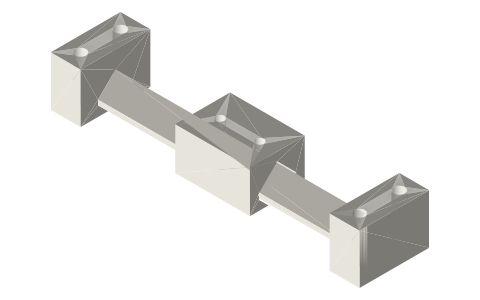
Print-in-place: linear slider on a dovetail rail with end stops (100 mm)
How do you 3D print a linear slide (carriage on a rail) in one piece? · Hardware · basis: Xem Studio design: 45° dovetail hexagon rail; one designed running gap of 0.40 mm
Also called: print in place slider, print in place linear rail, 3d printed linear slide, dovetail slide stl, print in place carriage
Exact dimensions. True size, with no tolerance added.
- length
- 124.0 mm
- width
- 28.0 mm
- height
- 20.0 mm
Notes
- 3D print in place — prints already assembled, moving, in one job. Drawn at true size with no printer tolerance added; the 0.40 mm running gaps are part of the design.
- Running gap 0.40 mm per side, 0.80 mm on diameter — part of the design, drawn as is. On the 45° faces the same 0.40 mm is measured square to the face (0.57 mm along the axis).
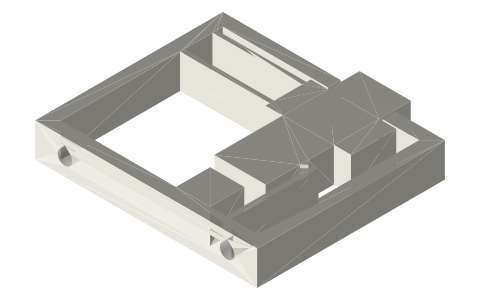
- Bed: the rail lies along X on its 6 mm foot with an end block at each end; the carriage stands on the bed straddling the rail, both of its legs reaching the bed beside the foot.
- Support while printing: the rail is a dovetail hexagon — it widens upward from the foot at 45° and closes at the top in a 45° ridge, so the carriage's channel has 45° walls and a 45° peaked roof; nothing is flat over air.
- Captured: the carriage's legs close under the rail's 45° flanks (the rail is 14 mm wide, the gap between the legs at the bed 7.1 mm), so it cannot lift off; the end blocks stop it at both ends.
- Freeing it: hold the rail and slide the carriage gently to each end stop and back a few times.
- Motion: 69.9 mm of travel, 35 mm each way from the drawn centre position; hard stops are the carriage ends on the end blocks (computed).
Print-in-place: linear slider on a dovetail rail with end stops size chart
| key | value | what |
|---|---|---|
| gap_mm | 0.4 | running gap per side on every moving interface (radial, axial, under captured parts) — part of the design, not a tolerance |
| rail_l_mm | 100.0 | between the end stops |
| rail_w_mm | 14 | across the widest flanks |
| rail_h_mm | 13 | to the 45° ridge |
| stem_w_mm | 6 | rail foot on the bed |
| carriage_l_mm | 30.0 | |
| carriage_w_mm | 22 | |
| carriage_h_mm | 17 | |
| travel_mm | 69.95 | stop to stop |
| travel_each_way_mm | 34.97 | from the drawn (centred) position |
| end_block_mm | 12 × 28 × 20 | each end stop, 2 × Ø4.5 |
| carriage_holes | 2 × Ø3.4, 30 apart | from the top into the channel |
Where the files are
Other publishers' files are linked, not hosted. "verify" = check the license at the link before commercial use.
| Xem Studio | Print-in-place mechanism design (geometry computed in the generator) | web | Xem Studio design |
Free files
★ Free files 3 parts. Xem Studio design: free to use, print and sell things from; not to be republished as files. Xem Studio Design License. index.json
Use this part in your AI. Your AI gets the exact sizes and files straight from Xem and can design a mount, case or adapter around it. Direct downloads here are limited to one file every 10 minutes; through your AI they are unlimited.
Connect Xem to your AI (free, no account, about a minute)
https://xemstudio.com/mcp- Claude: Add to Claude
- ChatGPT (Plus or higher): open Connectors → Advanced → turn on Developer mode → Create → paste the address, no authentication → Create.
- Cursor: install with one click. VS Code: install with one click.
| print-in-place-dovetail-slider-assembly | The whole print as laid on the bed (2 bodies, already assembled); STEP keeps each moving body a separate solid | STEP · STL |
| print-in-place-dovetail-slider-rail | Dovetail rail 100 mm with two end-stop blocks (4 × Ø4.5) | STEP · STL |
| print-in-place-dovetail-slider-carriage | Carriage 30 × 22 × 17 with the 45° dovetail channel, 2 × Ø3.4 | STEP · STL |
https://xemstudio.com/mcp to Claude, ChatGPT, Cursor or any MCP client (free, no account, one minute) and it can look up exact sizes, mating fits and free STEP/STL from every chat.Plain text: sheet.txt · JSON: /api/geometry?object=print-in-place-dovetail-slider
Fits with



Questions
How does the carriage stay on the rail?
The rail widens above its foot at 45°, like a dovetail; the carriage's legs wrap under that widening, 0.40 mm clear.
What limits the travel?
The end blocks: the 30 mm carriage runs between blocks 100 mm apart, so 69.9 mm.