 Xem Studiomeasured geometry
Library › Mechanisms › Linkages ·
Treadle and crank (crank-rocker four-bar)
How does a treadle turn a wheel? · Hardware · basis: Xem Studio design following Brown No. 158 (1868)
Also called: treadle crank, crank rocker, foot treadle mechanism, four bar crank rocker, pedal y manivela (manivela-balancín), Tretkurbel (Kurbelschwinge), crank-and-rocker linkage, crank and rocker linkage, crank-rocker linkage, crank rocker mechanism, rocker mechanism, rocker linkage
Exact dimensions. True size, with no tolerance added.
- sizes
- 7 in table
Notes
- Resize: multiply every length by one factor k and the motion stays identical: angles, ratios, timing and the formulas below do not change, because a mechanism's motion depends only on the ratios of its lengths. Here, scales with k: crank, connecting rod, treadle, frame, equal-time frame; stays the same: treadle swing, time ratio.
- Resize: fit clearances stay in mm (a slide fit is the same gap at any size); keep every printed wall and pin at least two nozzle widths; mass grows with k³ but part strength only with k², so at k = 2 parts are about 8× heavier and 4× stronger: check pins and thin links when scaling up.
- Swing: the rocker's two end positions are where crank and coupler line up, so cos ψ₁ = (c² + d² − (b + a)²) / 2cd and cos ψ₂ = (c² + d² − (b − a)²) / 2cd; swing = ψ₂ − ψ₁. Here (crank a 20, coupler/rod b 80, rocker c 100, frame d 100 mm) the swing is 25.08°. A longer crank a gives a bigger swing; a longer frame d or rocker c gives a smaller one.
- Time ratio (uneven swings): one swing takes 192.6° of crank rotation and the return 167.4°, so the return is 1.15× as fast (Q = (180° + α)/(180° − α), α = 12.6° between the two crank positions at the rocker's ends). Both swings take equal time only when a² + d² = b² + c²: for these a, b, c that is a frame of 126.5 mm.
- Rocker angle against crank angle (from mid-swing): 0°: +3.9°, 30°: -3.6°, 60°: -9.2°, 90°: -12.1°, 120°: -12.3°, 150°: -10.2°, 180°: -6.0°, 210°: -0.5°, 240°: +5.6°, 270°: +10.5°, 300°: +12.5°, 330°: +10.2°. The rocker slows to a stop at each end and is fastest in between; use it to time a part driven off the rocker against one driven straight off the crank.
- How link changes move it (rocker 100, coupler 80 held): crank 15 / frame 90: swing 20.2°, time ratio 1.16; crank 15 / frame 100: swing 18.8°, time ratio 1.11; crank 15 / frame 110: swing 17.9°, time ratio 1.07; crank 20 / frame 90: swing 26.9°, time ratio 1.22; crank 20 / frame 100: swing 25.1°, time ratio 1.15; crank 20 / frame 110: swing 23.9°, time ratio 1.09; crank 25 / frame 90: swing 33.7°, time ratio 1.28; crank 25 / frame 100: swing 31.4°, time ratio 1.19; crank 25 / frame 110: swing 29.9°, time ratio 1.11. Keep s + l ≤ p + q (Grashof) with the crank shortest, or the crank will not turn fully.
- A foot treadle rocking on a pivot drives a crank round through a connecting rod: a crank-rocker four-bar. Because the crank is the shortest link and next to the frame (Grashof: s + l ≤ p + q), it turns fully while the treadle only rocks.
- Here crank 20, rod 80, treadle 100 and frame 100 mm (catalog four-bar links): the treadle swings 25.08° per crank turn; a flywheel carries the crank through the two dead points where rod and crank line up.
- Brown's No. 158 (treadle driving a disc or crank), the drive of foot lathes, grinders and sewing machines.
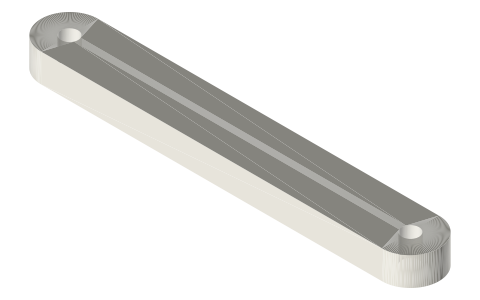
- Parts (each has its own page): four-bar-links, dowel-pins-metric.
- Brown's movement No. 158 (1868) shows it; this model is a Xem Studio design following his figure, every part at true size.
Treadle and crank size chart
| parameter | value |
|---|---|
| crank | 20 mm |
| connecting rod | 80 mm |
| treadle | 100 mm |
| frame | 100 mm |
| treadle swing | 25.08° |
| time ratio | 1.15 : 1 |
| equal-time frame | 126.5 mm |
Where the files are
Other publishers' files are linked, not hosted. "verify" = check the license at the link before commercial use.
| Henry T. Brown (1868, public domain) | Five Hundred and Seven Mechanical Movements — scan on archive.org | web | Publisher's page; dimensions are facts |
| 507movements.com | Brown's movement No. 158: figure, his text and an animation | web | Publisher's page; dimensions are facts |
Free files
★ Free files 1 parts. Xem Studio design: free to use, print and sell things from; not to be republished as files. Xem Studio Design License. index.json
Use this part in your AI. Your AI gets the exact sizes and files straight from Xem and can design a mount, case or adapter around it. Direct downloads here are limited to one file every 10 minutes; through your AI they are unlimited.
Connect Xem to your AI (free, no account, about a minute)
https://xemstudio.com/mcp- Claude: Add to Claude
- ChatGPT (Plus or higher): open Connectors → Advanced → turn on Developer mode → Create → paste the address, no authentication → Create.
- Cursor: install with one click. VS Code: install with one click.
| treadle-crank-mechanism-assembly | Assembled mechanism, all parts placed at one pose (STEP keeps each part separate) | STEP · STL |
https://xemstudio.com/mcp to Claude, ChatGPT, Cursor or any MCP client (free, no account, one minute) and it can look up exact sizes, mating fits and free STEP/STL from every chat.Plain text: sheet.txt · JSON: /api/geometry?object=treadle-crank-mechanism

Fits with

Questions
How does a treadle turn a wheel?
A foot treadle rocking on a pivot drives a crank round through a connecting rod: a crank-rocker four-bar. Because the crank is the shortest link and next to the frame (Grashof: s + l ≤ p + q), it turns fully while the treadle only rocks.