 Xem Studiomeasured geometry
Library › Electronic components › Generators & alternators ·
Linear alternator mover: Ø35 carrier for 16 Ø10 × 3 magnets
What does the moving magnet part of a linear alternator look like and what size is it? · Hardware · basis: Moving-magnet layout as in Sunpower / NASA convertors; pockets at the Ø10 × 3 disc magnet; checked in the generator (alt_check)
Also called: linear alternator mover, moving magnet linear generator, magnet carrier stl, free piston alternator magnets
Long Earth Society build part. Power take-off on the LES free-piston test bed. Long Earth Society
Exact dimensions. Every file is drawn at true size with no tolerance added. The holes and pins that meet another part are listed below under Mating features, with the fit each joint needs; open those by your process's clearance before making the part. Mating features
- sizes
- 7 in table
Notes
- The moving part of the linear alternator: a Ø35 × 26 carrier on a Ø12 × 6 hub, 32 mm overall, with a Ø5 bore (fit: slide) and a Ø2.5 radial hole (M3 tap size) in the hub for a grub screw.
- Two axial rows of 8 pockets (fit: press) for Ø10 × 3 disc magnets, faces out, 12 mm apart along the axis, the second row turned half a pocket. Row 1 all north out, row 2 all south out: the flux through each coil reverses as the mover passes.
- With magnets it is about 58 g, which adds to the piston's moving mass. It clamps the 5 mm piston tube or a Ø5 rod and sits centred in the coils at mid-stroke, 1.0 mm from the bobbin bore.
Linear alternator mover: Ø35 carrier for 16 Ø10 × 3 magnets size chart
| parameter | value |
|---|---|
| carrier | Ø35 × 26 |
| hub | Ø12 × 6 |
| bore | Ø5 |
| magnet pockets | 2 rows × 8, Ø10 × 3 |
| row pitch | 12 |
| air gap to bobbin | 1.0 |
| mass with magnets | ≈ 58 g |
Mating features
Drawn at the exact size. Open press, slide, run and socket features by your process's clearance (tolerances by process); leave designed gaps and clamp fits as drawn.
| feature | exact | mates with | fit | files |
|---|---|---|---|---|
| mover bore | Ø5 | 5 mm tube or Ø5 rod (M3 grub) | slide | alt-mover-* |
| magnet pockets | Ø10 × 3 | Ø10 × 3 disc magnet | press | alt-mover-* |
| mover grub hole | Ø2.5 | M3 tap drill | designed | alt-mover-* |
Where the files are
Other publishers' files are linked, not hosted. "verify" = check the license at the link before commercial use.
| NASA (NTRS, public domain) | Linear alternator design for free-piston Stirling convertors (2005) | US Government work, public domain | |
| NASA (NTRS, public domain) | Sunpower/NASA 80 We free-piston Stirling convertor (2002) | US Government work, public domain | |
| Wikipedia | Linear alternator | web | CC BY-SA 4.0 (text) |
| Wikipedia | Free-piston engine | web | CC BY-SA 4.0 (text) |
| Long Earth Society | Engine builds | web, video | LES site |
Free files
★ Free files 1 parts. Xem Studio design: free to use, print and sell things from; not to be republished as files. Xem Studio Design License. index.json
Use this part in your AI. Your AI gets the exact sizes and files straight from Xem and can design a mount, case or adapter around it. Direct downloads here are limited to one file every 10 minutes; through your AI they are unlimited.
Connect Xem to your AI (free, no account, about a minute)
https://xemstudio.com/mcp- Claude: Add to Claude
- ChatGPT (Plus or higher): open Connectors → Advanced → turn on Developer mode → Create → paste the address, no authentication → Create.
- Cursor: install with one click. VS Code: install with one click.
| alt-mover-35-2x8-10x3 | mover: Ø35 × 26 carrier with 2 axial rows of 8 Ø10 × 3 magnet pockets (faces out; row 1 all N out, row 2 all S out, rows offset half a pocket), 12 mm pitch, Ø5 bore, Ø12 hub with an M3 grub: clamps the 5 mm piston tube or a Ø5 rod | STEP · STL |
https://xemstudio.com/mcp to Claude, ChatGPT, Cursor or any MCP client (free, no account, one minute) and it can look up exact sizes, mating fits and free STEP/STL from every chat.Plain text: sheet.txt · JSON: /api/geometry?object=linear-alternator-mover

How it fits
Goes in or on
 Linear alternator bobbinruns inside the Ø37 bore, 1.0 mm gap
Connects to
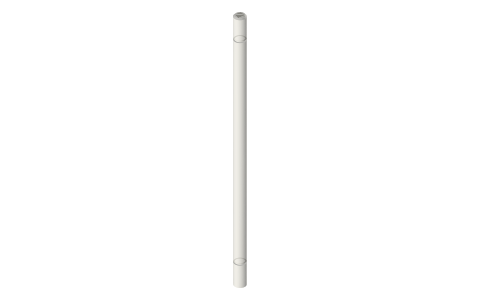 Ø5 rods with E-clip grooves, 120 and 150 mmclamps the Ø5 rod
 Tri-clamp end cap with Ø60, Ø80 and Ø100…clamps the 5 mm piston tube
 Planar spiral flexure bearing leavesflexures keep it centred in the gap
Also needed
 Neodymium disc magnets, common sizes16 × Ø10 × 3 in the pockets
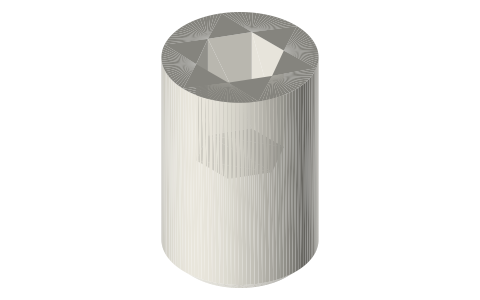 Set screws, M3–M8M3 grub in the hub
You might also need

Questions
Why two rows of magnets on a linear alternator mover?
Each coil must see the flux reverse as the mover passes; two rows of opposite polarity under two oppositely wound coils do that.
What magnets go in the mover?
Sixteen Ø10 × 3 disc magnets, eight per row, faces out.