 Xem Studiomeasured geometry
Library › Tri-clamp & pipe › Inserts & liners ·
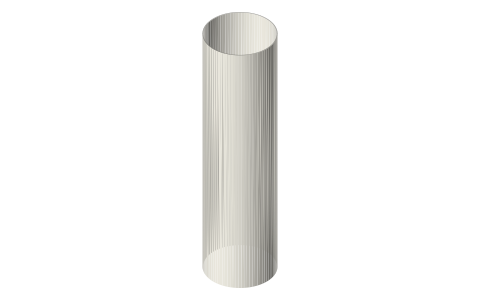
2 in tri-clamp tube liner, 0.5 wall, 140 and 180 mm
What thin liner fits inside a 2 inch tri-clamp tube? · Hardware · basis: Bore Ø47.5; lengths from the core layouts in tools/gen_ta_power.py
Also called: thermal buffer tube liner, thermoacoustic buffer tube 2 inch, pulse tube liner tri clamp
Long Earth Society build part. The buffer-tube liners in my generator cores. Long Earth Society
Exact dimensions. Every file is drawn at true size with no tolerance added. The holes and pins that meet another part are listed below under Mating features, with the fit each joint needs; open those by your process's clearance before making the part. Mating features
- sizes
- 2 in table
Notes
- The thermal buffer tube is the open length between the hot exchanger and the secondary ambient exchanger: the gas oscillates in it without touching anything, so the heat stays at the hot end. It runs hot end up (hot gas over cold), so it does not convect.
- The liner is what the hot exchanger stands on: a thin tube at the bore, 0.5 wall, so it conducts as little heat as it can (the model counts its conduction with the tube wall's).
- 180 mm in the ring engine's cores, 140 mm in the twin engine's: in the model the ring's gas moves about ±9 mm at the liner's ends, well inside its length.
- Fit: outside slide in the bore; the ends bear on the exchanger inserts.
2 in tri-clamp tube liner, 0.5 wall, 140 and 180 mm size chart
| file | outside (mm) | inside (mm) | length (mm) |
|---|---|---|---|
| tbt-liner-2in-140 | 47.5 | 46.5 | 140.0 |
| tbt-liner-2in-180 | 47.5 | 46.5 | 180.0 |
Mating features
Drawn at the exact size. Open press, slide, run and socket features by your process's clearance (tolerances by process); leave designed gaps and clamp fits as drawn.
| feature | exact | mates with | fit | files |
|---|---|---|---|---|
| outside | Ø47.5 | 2 in spool bore | slide | all |
| inside | Ø46.5 (0.5 wall) | gas passage (no contact) | designed | all |
| end faces | flat ring Ø46.5–Ø47.5 | hot and secondary exchanger inserts | designed | all |
Where the files are
Other publishers' files are linked, not hosted. "verify" = check the license at the link before commercial use.
| J. Acoust. Soc. Am. (S. Backhaus, G. W. Swift) | A thermoacoustic-Stirling heat engine: detailed study, JASA 107(6), 3148 (2000): torus with inertance and compliance, thermal buffer tube, jet pump against Gedeon streaming | web | journal article; cited verify |
| G. W. Swift (Acoustical Society of America / LANL) | Thermoacoustics: A Unifying Perspective for Some Engines and Refrigerators (Rott's equations, the energy equation, screen relations; the method behind DeltaEC) | web, book | cited verify |
| Long Earth Society | Engine builds | web, video | LES site |
Free files
★ Free files 2 parts. Xem Studio design: free to use, print and sell things from; not to be republished as files. Xem Studio Design License. index.json
Use this part in your AI. Your AI gets the exact sizes and files straight from Xem and can design a mount, case or adapter around it. Direct downloads here are limited to one file every 10 minutes; through your AI they are unlimited.
Connect Xem to your AI (free, no account, about a minute)
https://xemstudio.com/mcp- Claude: Add to Claude
- ChatGPT (Plus or higher): open Connectors → Advanced → turn on Developer mode → Create → paste the address, no authentication → Create.
- Cursor: install with one click. VS Code: install with one click.
| tbt-liner-2in-140 | thermal buffer tube liner Ø47.5 / Ø46.5 × 140 (0.5 wall) | STEP · STL |
| tbt-liner-2in-180 | thermal buffer tube liner Ø47.5 / Ø46.5 × 180 (0.5 wall) | STEP · STL |
https://xemstudio.com/mcp to Claude, ChatGPT, Cursor or any MCP client (free, no account, one minute) and it can look up exact sizes, mating fits and free STEP/STL from every chat.Plain text: sheet.txt · JSON: /api/geometry?object=tri-clamp-thin-tube-liner-2in
Fits with
Questions
Why so thin?
Every square millimetre of wall carries heat from the hot end to the cold end by conduction; the liner only has to locate the exchangers.