 Xem Studiomeasured geometry
Library › Hardware › Gears, cranks & flywheels ·
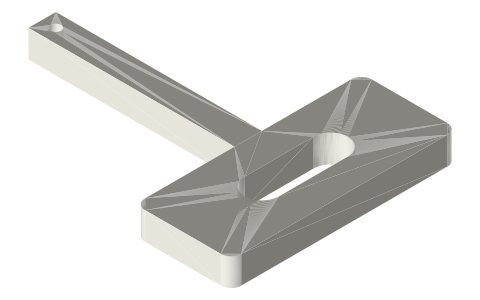
Scotch yoke: slotted yoke and crank disc, 20 and 30 mm stroke
How do I make a Scotch yoke? · Hardware · basis: Textbook Scotch yoke: slider displacement = r·sin θ, stroke = 2r; slot sized to a 623 bearing (OD 10) on a Ø3 crank pin, Ø5 shaft
Also called: scotch yoke stl, scotch yoke 3d print, slotted link mechanism, scotch yoke step file, yugo escocés, jugo escocês, Kreuzschleife, système bielle à coulisse
Used in Long Earth Society builds. Linear-to-rotational output converter
Exact dimensions. Every file is drawn at true size with no tolerance added. The holes and pins that meet another part are listed below under Mating features, with the fit each joint needs; open those by your process's clearance before making the part. Mating features
- sizes
- 2 in table
Notes
- A crank pin rides in a slot across the yoke, so the yoke moves as a pure sine of crank angle with no connecting rod and no rod angularity.
- Stroke is twice the pin offset: the 20 mm crank has its pin hole at 10 mm, the 30 mm crank at 15 mm.
- The slot is 10 mm wide for a 623 bearing (OD 10) on a Ø3 pin through the crank disc; the rod end has a Ø3 hole for the next link.
- Shorter than a crank and con-rod for the same stroke; used to drive displacers and pumps.
Scotch yoke: slotted yoke and crank disc, 20 and 30 mm stroke size chart
| stroke | parts | slot | crank pin offset |
|---|---|---|---|
| 20 mm | yoke + crank disc | 10 × 30 mm | 10 mm |
| 30 mm | yoke + crank disc | 10 × 40 mm | 15 mm |
Mating features
Drawn at the exact size. Open press, slide, run and socket features by your process's clearance (tolerances by process); leave designed gaps and clamp fits as drawn.
| feature | exact | mates with | fit | files |
|---|---|---|---|---|
| yoke slot width | 10 | 623 bearing OD 10 (rolls in it) | run | scotch-yoke-* |
| crank bore | Ø5 | Ø5 shaft | press | scotch-yoke-* |
| crank pin hole | Ø3 | Ø3 pin | press | scotch-yoke-* |
| rod-end hole | Ø3 | Ø3 pin (turns in it) | run | scotch-yoke-* |
Where the files are
Other publishers' files are linked, not hosted. "verify" = check the license at the link before commercial use.
| Wikipedia | Scotch yoke | web | CC BY-SA 4.0 (text) |
| Long Earth Society | Engine and rig builds on extrusion frames | web, video | LES site |
Free files
★ Free files 4 parts. Xem Studio design: free to use, print and sell things from; not to be republished as files. Xem Studio Design License. index.json
Use this part in your AI. Your AI gets the exact sizes and files straight from Xem and can design a mount, case or adapter around it. Direct downloads here are limited to one file every 10 minutes; through your AI they are unlimited.
Connect Xem to your AI (free, no account, about a minute)
https://xemstudio.com/mcp- Claude: Add to Claude
- ChatGPT (Plus or higher): open Connectors → Advanced → turn on Developer mode → Create → paste the address, no authentication → Create.
- Cursor: install with one click. VS Code: install with one click.
| scotch-yoke-20-yoke | Scotch yoke slider, 20 mm stroke, 10 mm slot for a 623 bearing on the crank pin, 8 mm rod with a Ø3 end hole | STEP · STL |
| scotch-yoke-20-crank | Scotch yoke crank disc, Ø3 pin hole at 10 mm (20 stroke), Ø5 bore | STEP · STL |
| scotch-yoke-30-yoke | Scotch yoke slider, 30 mm stroke, 10 mm slot | STEP · STL |
| scotch-yoke-30-crank | Scotch yoke crank disc, Ø3 pin hole at 15 mm (30 stroke), Ø5 bore | STEP · STL |
https://xemstudio.com/mcp to Claude, ChatGPT, Cursor or any MCP client (free, no account, one minute) and it can look up exact sizes, mating fits and free STEP/STL from every chat.Plain text: sheet.txt · JSON: /api/geometry?object=scotch-yoke
How it fits
Goes in or on
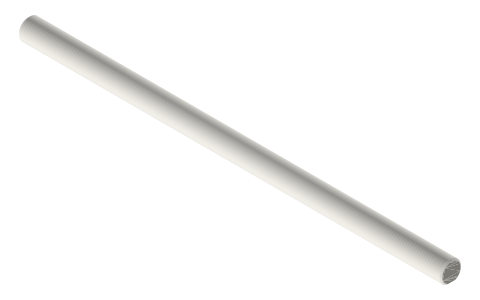 Crankshafts Ø3, Ø5 and Ø8 with full-length D-flatcrank disc on a Ø5 shaft
Connects to
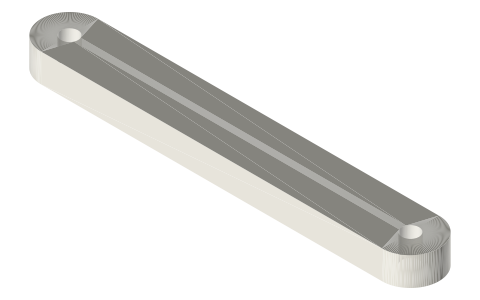 Four-bar linksØ3 hole in the rod end
Alternatives
 Swash plates Ø40 at 10, 15 and 20°multi-cylinder from one shaft
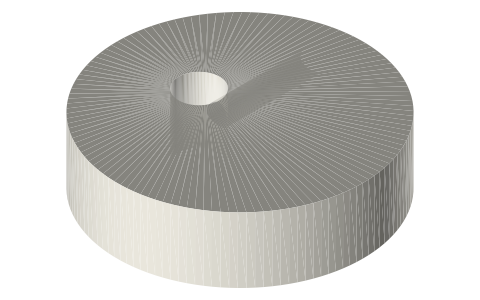 Eccentric sheaves Ø30 at 3, 5 and 8 mm offsetrotary to linear, no slot
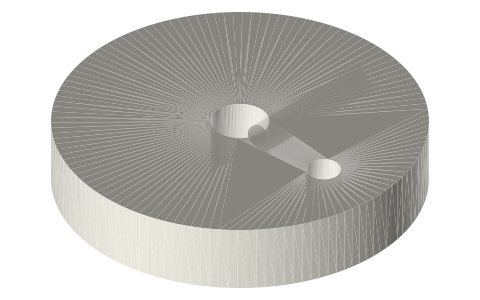 Crank discs for a Ø5 shaft, 10 to 50 mm strokecrank and con-rod
Also needed
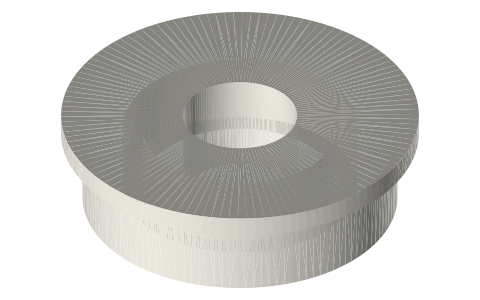 Ball bearings, 683 to 6210 and flanged F6xx623 on the crank pin, in the slot
 Dowel pins, 2–6 mmØ3 crank pin
You might also need

Questions
What is a Scotch yoke and when is it better than a con-rod?
A pin in a slot: the slider moves as a pure sine of crank angle with no connecting rod, so it is shorter and has no rod angularity. The pin takes the side load, so it carries a 623 bearing in the slot.
How do I get the stroke I want?
Stroke = 2 × the crank pin offset. Pick the 20 or 30 mm crank disc, or move the pin hole to half the stroke you need.