 Xem Studiomeasured geometry
Library › Mechanisms › Cams ·
3D printable 45° wedge slider: converts up/down motion to left/right (cam slider, STL, STEP)
What mechanism turns a push up and down into a slide left and right? · Hardware · basis: 45° wedge / cam slider: follower travel h = s·tan α, so 45° gives 1:1. Xem design, zero clearance.
Also called: vertical to horizontal motion, wedge slider stl, cam slider 3d print, diagonal cut slider, push down move sideways mechanism
Exact dimensions. Every file is drawn at true size with no tolerance added. The holes and pins that meet another part are listed below under Mating features, with the fit each joint needs; open those by your process's clearance before making the part. Mating features
- length
- 20.0 mm
- width
- 8.0 mm
- height
- 60.0 mm
Notes
- Resize: multiply every length by one factor k and the motion stays identical: angles, ratios, timing and the formulas below do not change, because a mechanism's motion depends only on the ratios of its lengths.
- Resize: Scale base radius and lift together: the motion law and the pressure angle stay the same. Raising lift alone steepens the pressure angle and the follower can jam.
- Resize: fit clearances stay in mm (a slide fit is the same gap at any size); keep every printed wall and pin at least two nozzle widths; mass grows with k³ but part strength only with k², so at k = 2 parts are about 8× heavier and 4× stronger: check pins and thin links when scaling up.
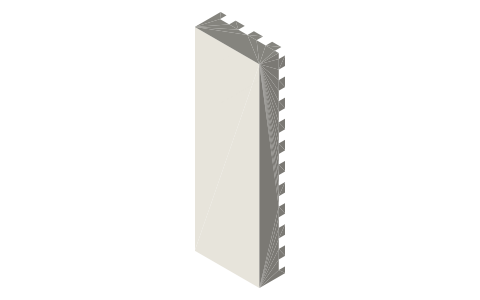
- Vertical slider carries 45° ribs, 2 mm deep at 4 mm pitch; horizontal slider carries matching grooves.
- Run each bar in its own guide (vertical and horizontal); 1 mm down moves the other bar 1 mm sideways.
- Add 0.15–0.2 mm on the rib faces for FDM. Print flat, ribs up.
3D printable 45° wedge slider: converts up/down motion to left/right size chart
| file | motion | overall mm |
|---|---|---|
| wedge-slider-vertical | up / down (input) | 20 × 8 × 60 |
| wedge-slider-horizontal | left / right (output) | 60 × 6 × 20 |
Mating features
Drawn at the exact size. Open press, slide, run and socket features by your process's clearance (tolerances by process); leave designed gaps and clamp fits as drawn.
| feature | exact | mates with | fit | files |
|---|---|---|---|---|
| rib faces | 45°, 2 mm deep, 4 mm pitch, zero clearance | the other slider | run | pair* |
Where the files are
Other publishers' files are linked, not hosted. "verify" = check the license at the link before commercial use.
| USPTO | US 5099708 Adjustable rolling cam slider (45° slant faces convert vertical to horizontal action) | web | Publisher's page; dimensions are facts |
| FIRGELLI | Wedge Cam Mechanism: How It Works, Formula h = s·tan(α) | web | Publisher's page; dimensions are facts |
Free files
★ Free files 2 parts. Xem Studio design: free to use, print and sell things from; not to be republished as files. Xem Studio Design License. index.json
Use this part in your AI. Your AI gets the exact sizes and files straight from Xem and can design a mount, case or adapter around it. Direct downloads here are limited to one file every 10 minutes; through your AI they are unlimited.
Connect Xem to your AI (free, no account, about a minute)
https://xemstudio.com/mcp- Claude: Add to Claude
- ChatGPT (Plus or higher): open Connectors → Advanced → turn on Developer mode → Create → paste the address, no authentication → Create.
- Cursor: install with one click. VS Code: install with one click.
| wedge-slider-vertical | Vertical slider: 20 × 60 mm bar with 45° ribs, 2 mm deep at 4 mm pitch; pushing it down drives the horizontal slider sideways | STEP · STL |
| wedge-slider-horizontal | Horizontal slider: 60 × 20 mm bar with matching 45° grooves, zero clearance; it moves left/right as the vertical slider moves up/down | STEP · STL |
https://xemstudio.com/mcp (free, no account). Your AI can then look up exact sizes, mating fits and free STEP/STL from every chat.Plain text: sheet.txt · JSON: /api/geometry?object=wedge-motion-converter
Fits with
Questions
How does a wedge convert vertical motion to horizontal?
The 45° faces slide on each other: each mm down on one bar pushes the other bar one mm sideways (h = s·tan α).
Why ribs instead of one wedge face?
Many short 45° ribs keep the parts compact and spread the load, so the stroke stays in a small block.
What clearance do the sliders need?
These are zero clearance; add 0.15–0.2 mm on the rib faces and run each bar in a guide.
Can I change the ratio?
A shallower angle gives more force and less travel; 45° gives 1:1.