 Xem Studiomeasured geometry
Library › Hardware › Gears, cranks & flywheels ·
Pawls for the Ø40 ratchet wheels: 12, 24 and 36 teeth
How is a pawl for a ratchet wheel shaped? · Hardware · basis: One pawl per wheel: Ø3 pivot 30 mm from the wheel axis, end face cut to lie on the steep face of a 3 mm tooth
Also called: pawl design, ratchet pawl stl, pawl dimensions, ratchet click pawl
Long Earth Society build part. Anti-reverse for the LES flywheel generators; same mechanism as a reel's clicker. Long Earth Society
Exact dimensions. Every file is drawn at true size with no tolerance added. The holes and pins that meet another part are listed below under Mating features, with the fit each joint needs; open those by your process's clearance before making the part. Mating features
- sizes
- 3 in table
Notes
- A flat pawl 6 thick with a Ø8 boss on a Ø3 pivot. Its end face is cut to lie on the wheel's steep tooth face over 80 % of the 3 mm tooth depth, so it drives and locks through face contact, not a point that can skate off the tooth corner.
- Set the pivot 30 mm from the wheel axis, 20° ahead of the tooth it drives (15° for the 36-tooth wheel). Checked: each pawl touches its wheel along the face with no overlap.
- The sloped tooth backs lift it on the free stroke; a spring holds it down (not drawn).
Pawls for the Ø40 ratchet wheels: 12, 24 and 36 teeth size chart
| file | wheel | pivot from wheel axis | pivot angle ahead | pivot to nose | thickness |
|---|---|---|---|---|---|
| pawl-12t-d40 | 12 teeth | 30 mm | 20° | 14.06 mm | 6 mm |
| pawl-24t-d40 | 24 teeth | 30 mm | 20° | 14.39 mm | 6 mm |
| pawl-36t-d40 | 36 teeth | 30 mm | 15° | 13.58 mm | 6 mm |
Mating features
Drawn at the exact size. Open press, slide, run and socket features by your process's clearance (tolerances by process); leave designed gaps and clamp fits as drawn.
| feature | exact | mates with | fit | files |
|---|---|---|---|---|
| pawl pivot hole | Ø3 | Ø3 pin (pawl turns on it) | run | pawl-* |
Where the files are
Other publishers' files are linked, not hosted. "verify" = check the license at the link before commercial use.
| Wikipedia | Ratchet (device) | web | CC BY-SA 4.0 (text) |
| Wikipedia | Pawl | web | CC BY-SA 4.0 (text) |
| Long Earth Society | Engine builds that use these parts (videos and write-ups) | web, video | LES site |
Free files
★ Free files 3 parts. Xem Studio design: free to use, print and sell things from; not to be republished as files. Xem Studio Design License. index.json
Use this part in your AI. Your AI gets the exact sizes and files straight from Xem and can design a mount, case or adapter around it. Direct downloads here are limited to one file every 10 minutes; through your AI they are unlimited.
Connect Xem to your AI (free, no account, about a minute)
https://xemstudio.com/mcp- Claude: Add to Claude
- ChatGPT (Plus or higher): open Connectors → Advanced → turn on Developer mode → Create → paste the address, no authentication → Create.
- Cursor: install with one click. VS Code: install with one click.
| pawl-12t-d40 | pawl for the 12-tooth Ø40 wheel: Ø8 boss on a Ø3 pivot 30 mm from the wheel axis, 20° ahead of the tooth it drives, nose 14.06 mm from the pivot, end face on 80 % of the tooth's steep face; spring not modeled | STEP · STL |
| pawl-24t-d40 | pawl for the 24-tooth Ø40 wheel: Ø8 boss on a Ø3 pivot 30 mm from the wheel axis, 20° ahead of the tooth it drives, nose 14.39 mm from the pivot, end face on 80 % of the tooth's steep face; spring not modeled | STEP · STL |
| pawl-36t-d40 | pawl for the 36-tooth Ø40 wheel: Ø8 boss on a Ø3 pivot 30 mm from the wheel axis, 15° ahead of the tooth it drives, nose 13.58 mm from the pivot, end face on 80 % of the tooth's steep face; spring not modeled | STEP · STL |
https://xemstudio.com/mcp to Claude, ChatGPT, Cursor or any MCP client (free, no account, one minute) and it can look up exact sizes, mating fits and free STEP/STL from every chat.Plain text: sheet.txt · JSON: /api/geometry?object=ratchet-pawl

How it fits
Connects to
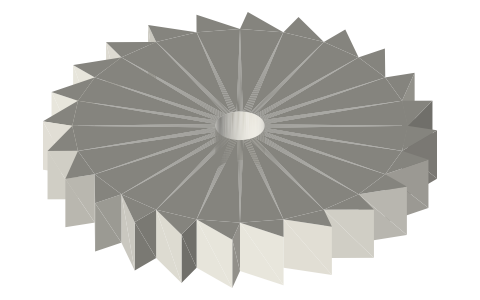 Ratchet wheels Ø40 with 12, 24 and 36 teethtip on the Ø40 wheel's teeth
Also needed
 Crank and wrist pins Ø3 × 12, 16, 19, 20 and 23Ø3 pivot pin
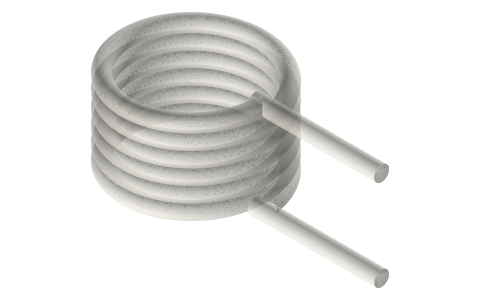 Torsion spring wire Ø0.8, OD 8, 6 coilspawl return
You might also need

Questions
Where does the pawl pivot go?
30 mm from the wheel's axis, 20° ahead of the tooth it drives (15° on the 36-tooth wheel), on a Ø3 pin.
Why is the tip flat, not pointed?
A flat end face sits on the tooth's steep face, so load pushes the pawl deeper instead of skating it off the tooth corner.